
Purchase any WEBINAR and get
10% Off
CODE: SAVE10
T&C applicable, please referFAQ
Validity : 20th Jun'26 to 30th Jun'26
Software validation remains one of the most scrutinized areas during FDA inspections due to its direct impact on data integrity, product quality, and patient safety. As life sciences organizations continue to adopt digital systems—ranging from manufacturing execution systems and laboratory platforms to cloud-based SaaS solutions—the complexity of validation expectations has increased. Regulatory frameworks such as 21 CFR Part 11 and EU Annex 11 establish expectations for electronic records and signatures, but they rely on the foundational assumption that systems are properly validated.
Despite decades of guidance, FDA continues to cite software validation deficiencies as a recurring issue in 483 observations and Warning Letters. These deficiencies are rarely due to lack of effort; instead, they stem from misunderstanding regulatory intent, poor planning, weak user involvement, and over-reliance on vendors. This webinar addresses these systemic issues by focusing on the most common validation failures observed in real-world inspections and providing practical strategies to correct them.
Software validation is not a one-time testing activity—it is a lifecycle process that ensures systems consistently perform as intended for their defined use. In FDA-regulated environments, this expectation extends to any system that creates, modifies, stores, or transmits GxP data. As organizations increasingly rely on digital systems, the importance of validation has grown, not only for compliance but also for operational reliability and efficiency.
This webinar provides a structured and practical examination of software validation and verification within the context of FDA expectations. It begins by clarifying foundational concepts such as intended use, validation versus verification, and the regulatory frameworks that govern electronic systems, including 21 CFR Part 11 and EU Annex 11. It then explores how validation requirements apply across different system types, including on-premise systems, SaaS platforms, and cloud-hosted solutions, emphasizing shared responsibility between vendors and regulated companies.
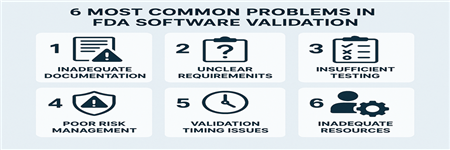
The session focuses heavily on the six most common problems observed in FDA software validation: poor planning, weak user involvement, over-reliance on vendors, inadequate testing strategies, ineffective change control decisions, and misuse of traceability. Each problem is examined in detail, including how it appears in practice, why it occurs, and how inspectors identify it during audits.
In addition, the webinar explains how risk-based validation principles should be applied to scale effort appropriately, ensuring that high-risk systems receive the necessary level of control while avoiding unnecessary burden on low-risk systems. Practical strategies are provided to improve validation planning, strengthen collaboration between QA, IT, and users, and implement sustainable validation programs.
The session also addresses inspection readiness, explaining how validation deficiencies lead to FDA 483 observations and how organizations can present clear, defensible validation evidence during inspections. Real-world scenarios and frequently asked questions are incorporated to clarify common industry misunderstandings, including topics such as spreadsheet validation, tester independence, and revalidation requirements.
By the end of the session, participants will have a clear, inspection-focused understanding of software validation expectations and the tools needed to build compliant, efficient, and sustainable validation programs.
Software validation continues to be one of the most misunderstood and high-risk areas in regulated environments. Many organizations invest significant time and resources into validation activities, yet still face FDA observations, delayed system releases, and operational inefficiencies. The root cause is not usually lack of effort—it is lack of clarity. Teams struggle with defining scope, applying risk-based thinking, involving the right stakeholders, and interpreting regulatory expectations correctly.
This uncertainty creates a cycle of over-validation and under-validation at the same time. Low-risk systems are burdened with unnecessary documentation, while high-risk systems lack sufficient control. Organizations often rely too heavily on vendors, assuming “vendor validated” systems meet FDA expectations, only to discover during inspections that accountability cannot be outsourced. At the same time, weak testing strategies, poor change control decisions, and misapplied traceability create gaps that directly impact data integrity.
FDA inspectors are increasingly system-focused and evidence-driven. They expect clear rationale, consistent application of controls, and documentation that tells a logical story. When validation programs lack structure, inspectors quickly identify inconsistencies that lead to 483 observations or worse.
This webinar eliminates the confusion. It provides a clear, inspection-focused understanding of software validation expectations and breaks down the six most common problems that repeatedly lead to compliance failures. More importantly, it shows how to fix them—using practical, risk-based approaches that improve both compliance and operational efficiency. Attendees will leave with the ability to confidently design, execute, and defend validation programs that meet regulatory expectations without unnecessary complexity.

Charles H. Paul is the President of C. H. Paul Consulting, Inc. – a regulatory, training, and technical documentation consulting firm. Charles is a management consultant, instructional designer and regulatory consultant and has led C. H. Paul Consulting, Inc. since its inception over 25 years ago. He regularly consults with Fortune 500 pharmaceutical, medical device, and biotechnology firms assisting them in achieving human resource, regulatory, and operational excellence. He is a regular presenter of webinars and on-site seminars in a variety of related subjects from documentation development to establishing compliant preventive maintenance systems.


