
Purchase any WEBINAR and get
10% Off
CODE: SAVE10
T&C applicable, please referFAQ
Validity : 06th May'26 to 16th May'26
The “Zero Smashes” Case Study That Prevented Catastrophic Start-Up Failures and Saved $100K+ per Incident Across 35 Manufacturing Presses
Manufacturing environments that rely on heavy mechanical equipment face significant risk when machines return to service following major repairs. Despite formal inspection procedures, incomplete or inconsistent checks often allow hidden defects to go undetected. These latent failures surface during startup, frequently resulting in catastrophic equipment damage, extended downtime, and costly rework.
In a battery casing manufacturing facility operating 35 individual cam-operated presses, incomplete post-repair inspections resulted in repeated machine “smashes” during startup. Failures occurred approximately every two months, creating cascading production delays, 4–6 month parts lead times, and repair costs exceeding $100,000 per incident. The true cost—including lost production, schedule disruption, and workforce stress—was substantially higher.
This session presents a detailed case study of how a structured human error elimination strategy transformed the inspection process and drove these failures to zero.
Human error is often blamed after equipment failures, but rarely is it systematically eliminated. Organizations tend to respond with more training, reminders, or disciplinary actions—yet the same failures repeat. Why? Because most inspection systems depend on memory, experience, and individual judgment rather than engineered reliability.
This webinar walks participants through a detailed, real-world case study that demonstrates how human error elimination can be achieved through process design rather than people-focused fixes.
The setting is a high-volume manufacturing operation producing battery casings using 35 individual cam-operated presses. These machines operate under significant mechanical stress and require major component repairs after certain failures. Following repairs, presses were returned to service after inspections that were considered complete and compliant. However, hidden broken or misaligned components routinely went undetected.
When restarted, the equipment would experience catastrophic mechanical “smashes,” resulting in secondary failures often worse than the original breakdown. Each incident triggered 4–6 months of downtime waiting for specialty components, along with repair costs averaging $100,000. Lost production compounded the financial impact. With failures occurring approximately every two months across the fleet, the cumulative costs were staggering.
The organization initially treated these events as unavoidable mechanical risk. But deeper analysis revealed a different story: inspection processes varied by technician, relied heavily on memory, lacked standardized criteria, and had no independent verification. In short, the system allowed human error to pass undetected.
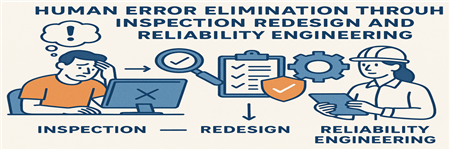
This session explains how the team redesigned the inspection process using human reliability and operational excellence principles. Instead of asking technicians to “be more careful,” they engineered a system that made incomplete inspections difficult to perform.
Participants will learn how the team:
The result was dramatic: startup crashes were eliminated, downtime decreased, maintenance predictability improved, and significant cost savings were realized.
More importantly, the approach proved transferable. The same human error elimination methods can be applied to GMP environments, regulated industries, utilities, and any operation where inspection reliability directly affects safety, compliance, or uptime.
Participants will leave with practical tools and templates that can be immediately applied to their own maintenance, quality, and operational processes.
This is not theory—it is a proven field application that delivered measurable results.
If you operate complex equipment, you are already one missed step away from your next catastrophic failure.
Most organizations assume their inspection procedures work—until a machine destroys itself on startup after a repair. Then everyone asks the same question: “How did we miss that?”
The uncomfortable truth is this: most inspection failures are not technical problems. They are human reliability problems.
Incomplete checks. Assumptions. Time pressure. Memory-based inspections. Informal sign-offs. “Looks good to me.”
And when those small behaviors combine with heavy industrial equipment, the consequences are anything but small.
One overlooked component can turn into:
In the featured case study, 35 presses experienced catastrophic crashes roughly every other month. Repairs took 4–6 months. The organization normalized the losses as “just part of operations.” But the real issue wasn’t bad equipment—it was unreliable inspections.
This webinar shows exactly how that pattern was broken.
You’ll see how a team moved beyond retraining and rewriting SOPs and instead redesigned the system using human factors principles, inspection standardization, verification methods, and practical error-proofing. The result? Machine smashes dropped to zero.
If you are responsible for maintenance, quality, engineering, GMP compliance, or operational reliability, this session will help you identify where hidden human error risks are sitting quietly in your own processes—waiting to become your next expensive failure.
Because the next “startup smash” isn’t bad luck.
It’s predictable.
And preventable.

Charles H. Paul is the President of C. H. Paul Consulting, Inc. – a regulatory, training, and technical documentation consulting firm. Charles is a management consultant, instructional designer and regulatory consultant and has led C. H. Paul Consulting, Inc. since its inception over 25 years ago. He regularly consults with Fortune 500 pharmaceutical, medical device, and biotechnology firms assisting them in achieving human resource, regulatory, and operational excellence. He is a regular presenter of webinars and on-site seminars in a variety of related subjects from documentation development to establishing compliant preventive maintenance systems.


